Ask ten business owners to define “digital marketing,” and you’ll get ten different, half-right answers. Some say it’s social media. Others mean ads. A few mean the whole website. None of them are wrong; they’re just each describing one room in a much larger house.
That vagueness is expensive. A company that doesn’t know the difference between SEO and PPC will happily throw budget at both without ever asking which one is producing customers and which one is quietly burning cash while looking busy. Businesses that map spending against clear, service-specific KPIs see roughly double the ROI of those that don’t, which sounds like a marketing-department talking point until you sit with why: you can’t optimize what you haven’t separated.
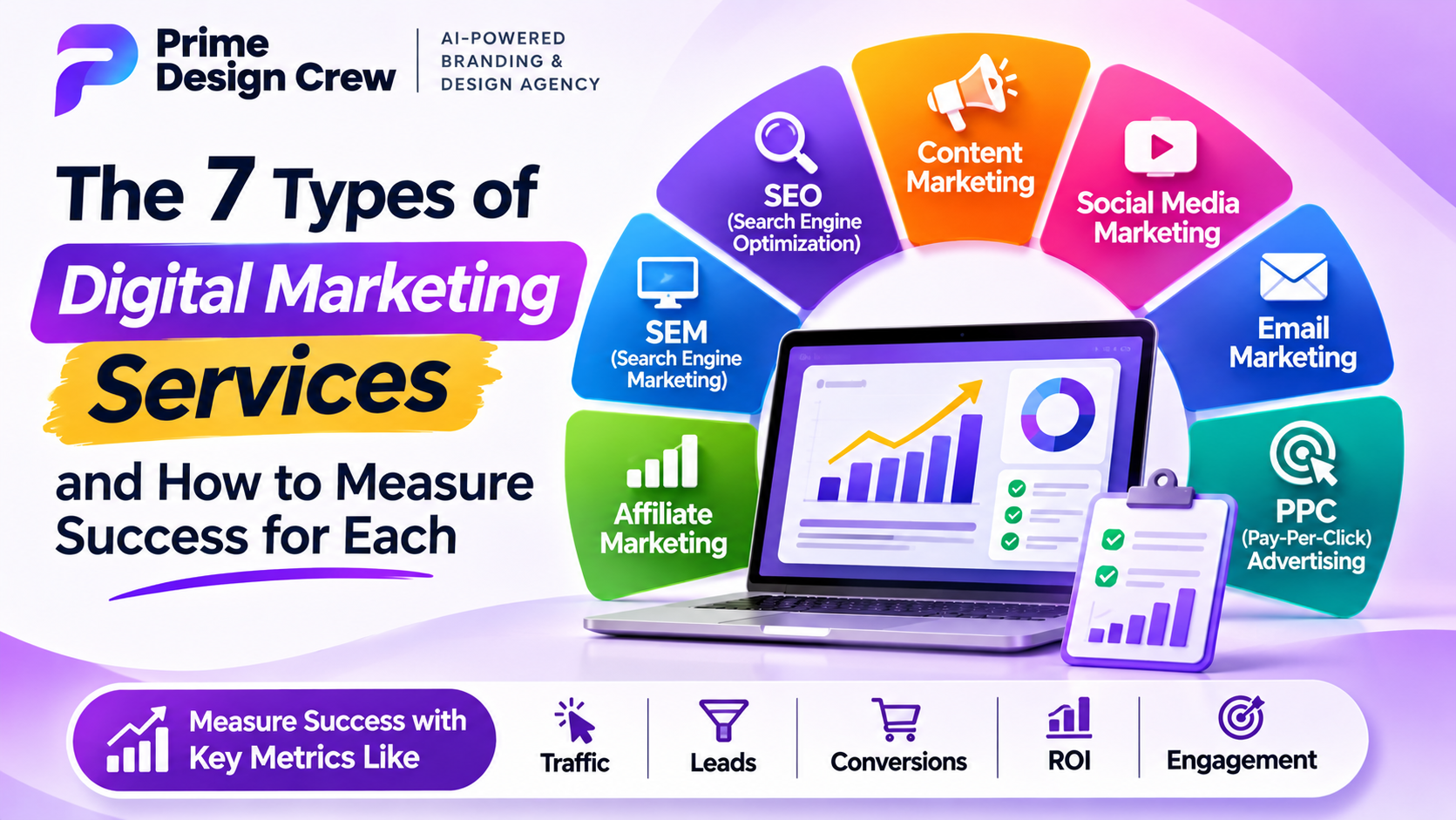
So here’s the breakdown: seven distinct types of digital marketing services, what each one does, and the specific number that tells you whether it’s working.
1. SEO: The Slow Compound Interest of Marketing
Search engine optimization is the practice of shaping a website and its content so it ranks organically for the terms people are already searching. On-page SEO, technical fixes, backlink building, local listings different mechanics, same goal.
It behaves a bit like planting an orchard. Nothing happens for months. Then, slowly, the trees start bearing fruit every season without anyone having to replant them. Organic traffic in Google Analytics 4, keyword rankings tracked through tools like Ahrefs or SEMrush, and click-through rate from the search results page are the three numbers that matter here. Expect three to six months before the trend becomes obvious.
2. PPC: Buying Your Way to the Top of the Page
Pay-per-click advertising is the opposite instinct entirely: instead of earning a position, you’re renting one. Google Ads, Bing Ads, display placements, shopping ads. The mechanics vary by platform, but the principle stays the same: pay when someone clicks.
Cost per click, conversion rate, and return on ad spend are the metrics worth watching daily, not monthly. Results show up within days, which is exactly why PPC gets over-funded relative to slower channels; it’s the marketing equivalent of a vending machine, satisfying in the moment, less useful for building anything that lasts.
3. Social Media Marketing: Presence, Not Just Posting
Social media marketing covers organic posting, community engagement, influencer collaborations, and paid social campaigns across Instagram, Facebook, LinkedIn, and TikTok wherever an audience spends time. Engagement rate (likes, comments, and shares divided by reach), follower growth, and social referral traffic are the numbers that matter. Organic growth takes one to three months to show a real pattern; paid social, like PPC, moves fast.
Is a like the same thing as a customer? Obviously not. But a healthy engagement rate is often the earliest signal that content is resonating before any of it translates into revenue.
4. Content Marketing: Playing the Long Game on Purpose
Content marketing: blog posts, YouTube videos, podcasts, downloadable guides and webinars exist to attract and educate an audience before they’re ready to buy. Time on page, lead magnet downloads, and content-assisted conversions are the metrics to track, and none of them show much movement for four to six months.
Get Prime Design Crew’s stories in your inbox
Join Medium for free to get updates from this writer.
This is where a lot of businesses lose patience, and understandably so.
5. Email Marketing: Still the Highest-ROI Channel Nobody Talks About
Email marketing rarely gets the spotlight that social media does, which is a little odd given how consistently it outperforms flashier channels on cost per dollar returned. Newsletters, abandoned cart sequences, welcome flows and promotional campaigns are all built on a list a business owns, unlike a social following that lives at the mercy of a platform’s algorithm. Open rate, click-through rate, unsubscribe rate, and revenue per email sent tell the whole story. With a warm, engaged list, results show up almost immediately.
6. Affiliate and Influencer Marketing: Borrowed Trust
Affiliate and influencer marketing means partnering with people who already have an audience’s attention and, more importantly, their trust and paying them a commission or fee to promote a product. Affiliate revenue, cost per acquisition, and influencer engagement rate are the figures to track. Traction usually builds over one to three months, once the right partners are found and the awkward early testing phase is over.
7. Marketing Automation: The Quiet Multiplier
Marketing automation isn’t really a channel at all; it’s the infrastructure underneath the other six. Tools like HubSpot, Mailchimp, and Zapier automate repetitive work: email sequences, social scheduling, lead scoring, CRM syncing. Time saved per week, lead-to-customer conversion rate, and automation-assisted revenue are what to measure. Efficiency gains show up immediately; full optimization takes two to three months of tuning workflows.
Measuring the Whole System
Here’s the harder question, the one that trips up even experienced marketers: each of these seven services has its own metrics, its own rhythm, its own timeline. So how does anyone measure the combined effect?
The honest answer is that most businesses can’t, not without deliberately building for it. This is where a full-funnel digital marketing strategy earns its keep by layering multi-touch attribution (available inside Google Analytics 4) over the individual channel data, so a sale doesn’t get credited entirely to whichever ad happened to be clicked last. Customer acquisition cost, customer lifetime value, and overall marketing ROI become the cross-channel numbers that matter. UTM parameters on every campaign make this possible in practice; without them, this entire exercise in how to measure digital marketing success collapses into guesswork.
Which Services Deserve Your Budget First
A business running under $1,000 a month should generally start with SEO and email marketing, both cheap relative to their return, both compounding rather than resetting each month. A company that needs sales now, not in six months, is better served by PPC and paid social. Long-term brand building points toward content marketing paired with SEO, a slower but sturdier combination. B2B companies tend to see the strongest returns from LinkedIn and email, while B2C e-commerce brands usually do better prioritizing Instagram or TikTok alongside PPC and email.
None of this is really about digital marketing vs traditional marketing anymore; that debate matters less once a business understands that digital marketing was never one thing to begin with. It’s seven, at least, each with its own logic and its own clock.
Pick two or three to start. Set the KPIs before the campaign launches, not after. Review monthly, and be honest about what the numbers are saying, even when what they’re saying isn’t what the plan hoped for.Ask ten business owners to define “digital marketing,” and you’ll get ten different, half-right answers. Some say it’s social media. Others mean ads. A few mean the whole website. None of them are wrong; they’re just each describing one room in a much larger house.
That vagueness is expensive. A company that doesn’t know the difference between SEO and PPC will happily throw budget at both without ever asking which one is producing customers and which one is quietly burning cash while looking busy. Businesses that map spending against clear, service-specific KPIs see roughly double the ROI of those that don’t, which sounds like a marketing-department talking point until you sit with why: you can’t optimize what you haven’t separated.
So here’s the breakdown: seven distinct types of digital marketing services, what each one does, and the specific number that tells you whether it’s working.
1. SEO: The Slow Compound Interest of Marketing
Search engine optimization is the practice of shaping a website and its content so it ranks organically for the terms people are already searching. On-page SEO, technical fixes, backlink building, local listings different mechanics, same goal.
It behaves a bit like planting an orchard. Nothing happens for months. Then, slowly, the trees start bearing fruit every season without anyone having to replant them. Organic traffic in Google Analytics 4, keyword rankings tracked through tools like Ahrefs or SEMrush, and click-through rate from the search results page are the three numbers that matter here. Expect three to six months before the trend becomes obvious.
2. PPC: Buying Your Way to the Top of the Page
Pay-per-click advertising is the opposite instinct entirely: instead of earning a position, you’re renting one. Google Ads, Bing Ads, display placements, shopping ads. The mechanics vary by platform, but the principle stays the same: pay when someone clicks.
Cost per click, conversion rate, and return on ad spend are the metrics worth watching daily, not monthly. Results show up within days, which is exactly why PPC gets over-funded relative to slower channels; it’s the marketing equivalent of a vending machine, satisfying in the moment, less useful for building anything that lasts.
3. Social Media Marketing: Presence, Not Just Posting
Social media marketing covers organic posting, community engagement, influencer collaborations, and paid social campaigns across Instagram, Facebook, LinkedIn, and TikTok wherever an audience spends time. Engagement rate (likes, comments, and shares divided by reach), follower growth, and social referral traffic are the numbers that matter. Organic growth takes one to three months to show a real pattern; paid social, like PPC, moves fast.
Is a like the same thing as a customer? Obviously not. But a healthy engagement rate is often the earliest signal that content is resonating before any of it translates into revenue.
4. Content Marketing: Playing the Long Game on Purpose
Content marketing: blog posts, YouTube videos, podcasts, downloadable guides and webinars exist to attract and educate an audience before they’re ready to buy. Time on page, lead magnet downloads, and content-assisted conversions are the metrics to track, and none of them show much movement for four to six months.
Get Prime Design Crew’s stories in your inbox
Join Medium for free to get updates from this writer.
Enter your email
Subscribe
Remember me for faster sign in
This is where a lot of businesses lose patience, and understandably so.
5. Email Marketing: Still the Highest-ROI Channel Nobody Talks About
Email marketing rarely gets the spotlight that social media does, which is a little odd given how consistently it outperforms flashier channels on cost per dollar returned. Newsletters, abandoned cart sequences, welcome flows and promotional campaigns are all built on a list a business owns, unlike a social following that lives at the mercy of a platform’s algorithm. Open rate, click-through rate, unsubscribe rate, and revenue per email sent tell the whole story. With a warm, engaged list, results show up almost immediately.
6. Affiliate and Influencer Marketing: Borrowed Trust
Affiliate and influencer marketing means partnering with people who already have an audience’s attention and, more importantly, their trust and paying them a commission or fee to promote a product. Affiliate revenue, cost per acquisition, and influencer engagement rate are the figures to track. Traction usually builds over one to three months, once the right partners are found and the awkward early testing phase is over.
7. Marketing Automation: The Quiet Multiplier
Marketing automation isn’t really a channel at all; it’s the infrastructure underneath the other six. Tools like HubSpot, Mailchimp, and Zapier automate repetitive work: email sequences, social scheduling, lead scoring, CRM syncing. Time saved per week, lead-to-customer conversion rate, and automation-assisted revenue are what to measure. Efficiency gains show up immediately; full optimization takes two to three months of tuning workflows.
Measuring the Whole System
Here’s the harder question, the one that trips up even experienced marketers: each of these seven services has its own metrics, its own rhythm, its own timeline. So how does anyone measure the combined effect?
The honest answer is that most businesses can’t, not without deliberately building for it. This is where a full-funnel digital marketing strategy earns its keep by layering multi-touch attribution (available inside Google Analytics 4) over the individual channel data, so a sale doesn’t get credited entirely to whichever ad happened to be clicked last. Customer acquisition cost, customer lifetime value, and overall marketing ROI become the cross-channel numbers that matter. UTM parameters on every campaign make this possible in practice; without them, this entire exercise in how to measure digital marketing success collapses into guesswork.
Which Services Deserve Your Budget First
A business running under $1,000 a month should generally start with SEO and email marketing, both cheap relative to their return, both compounding rather than resetting each month. A company that needs sales now, not in six months, is better served by PPC and paid social. Long-term brand building points toward content marketing paired with SEO, a slower but sturdier combination. B2B companies tend to see the strongest returns from LinkedIn and email, while B2C e-commerce brands usually do better prioritizing Instagram or TikTok alongside PPC and email.
None of this is really about digital marketing vs traditional marketing anymore; that debate matters less once a business understands that digital marketing was never one thing to begin with. It’s seven, at least, each with its own logic and its own clock.
Pick two or three to start. Set the KPIs before the campaign launches, not after. Review monthly, and be honest about what the numbers are saying, even when what they’re saying isn’t what the plan hoped for.